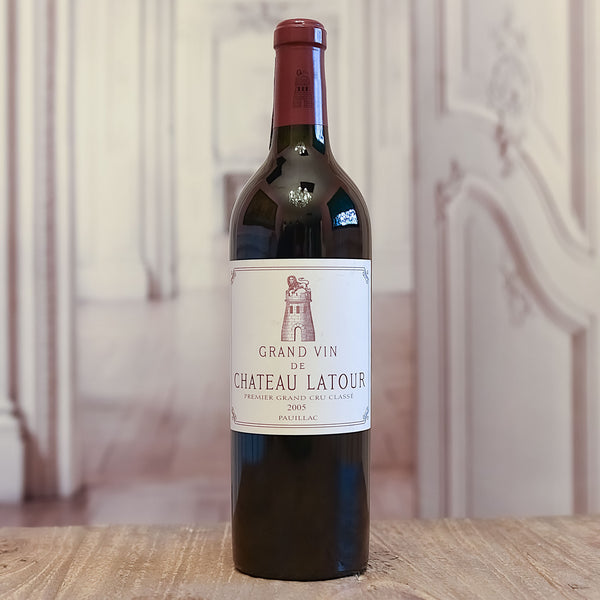

Château Latour occupies the southeastern corner of Pauillac, in the Médoc north of Bordeaux, where the vineyard runs down toward the Gironde estuary at the boundary with Saint-Julien. A tower built on the site in the fourteenth century, the Tour de Saint-Lambert, gave the estate its name, and the wine's reputation reaches back at least to the sixteenth century, when it was noted in Montaigne's Essays. Ownership passed through the Ségur family from the seventeenth century before moving, in 1963, to British interests under the Pearson Group; since 1993 the estate has belonged to François Pinault's Groupe Artemis.
Latour was ranked a First Growth in the 1855 Bordeaux Classification, one of only five estates to hold that status. The property extends across 78 hectares, at the heart of which lies L'Enclos, a 47-hectare walled parcel largely unchanged since 1794. Only fruit grown within L'Enclos goes into the grand vin. The soils vary by section: deep beds of gravel and clay at the center, more marl to the north and south, with gravel running four to five metres down over a dense clay the estate calls argile gonflante.
The vineyard is planted mainly to Cabernet Sauvignon, with Merlot, Cabernet Franc and Petit Verdot in support; the grand vin itself is typically built on roughly three quarters Cabernet Sauvignon and a fifth Merlot. Latour was the first of the Bordeaux first growths to abandon oak fermenting vats for temperature-controlled stainless steel, in the early 1960s, and its cellar has worked by gravity since a 2001 renovation, with eighty vats of varying size allowing each parcel to be vinified on its own. The grand vin ages in new French oak.
Since the late 2000s the estate has farmed increasingly along organic and biodynamic lines, working horses through parts of the vineyard to ease soil compaction; L'Enclos has been certified organic since 2018. In 2012 Latour stepped outside the en primeur system that governs most Bordeaux futures, choosing instead to hold back its wines and release them only when the estate judges them ready to drink.
Below the grand vin sits Les Forts de Latour, drawn from younger vines within L'Enclos and produced in most vintages since 1966, aged in a smaller proportion of new oak. A third wine, Pauillac de Château Latour, was introduced in 1965 for fruit not selected for either of the estate's other bottlings.
i.WINE currently carries the Château Latour, Pauillac 2005, the Les Forts de Latour, Pauillac 2016, and the Pauillac of Château Latour 2016.